Deterministic compliance engine
Requirements are resolved from a curated dataset of UN numbers, hazard classes and packing groups — not improvised by a language model. Same shipment, same verdict, every time.
Point your camera. Get instant UN classification, compliance checks, and regulatory checklists powered by AI. Built for the pace of modern freight operations.
Web · iOS · Android
Built on the regulations you trust
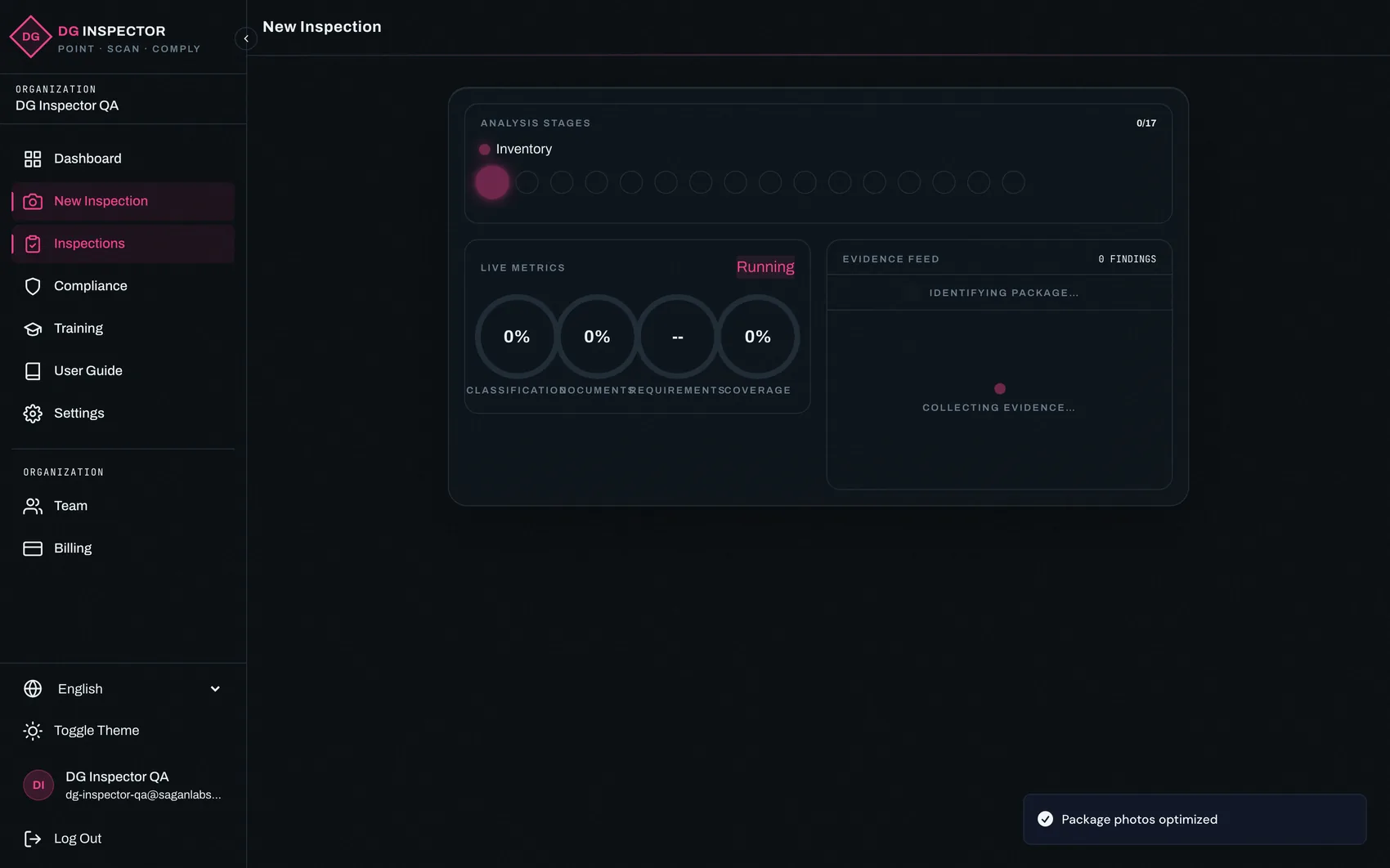
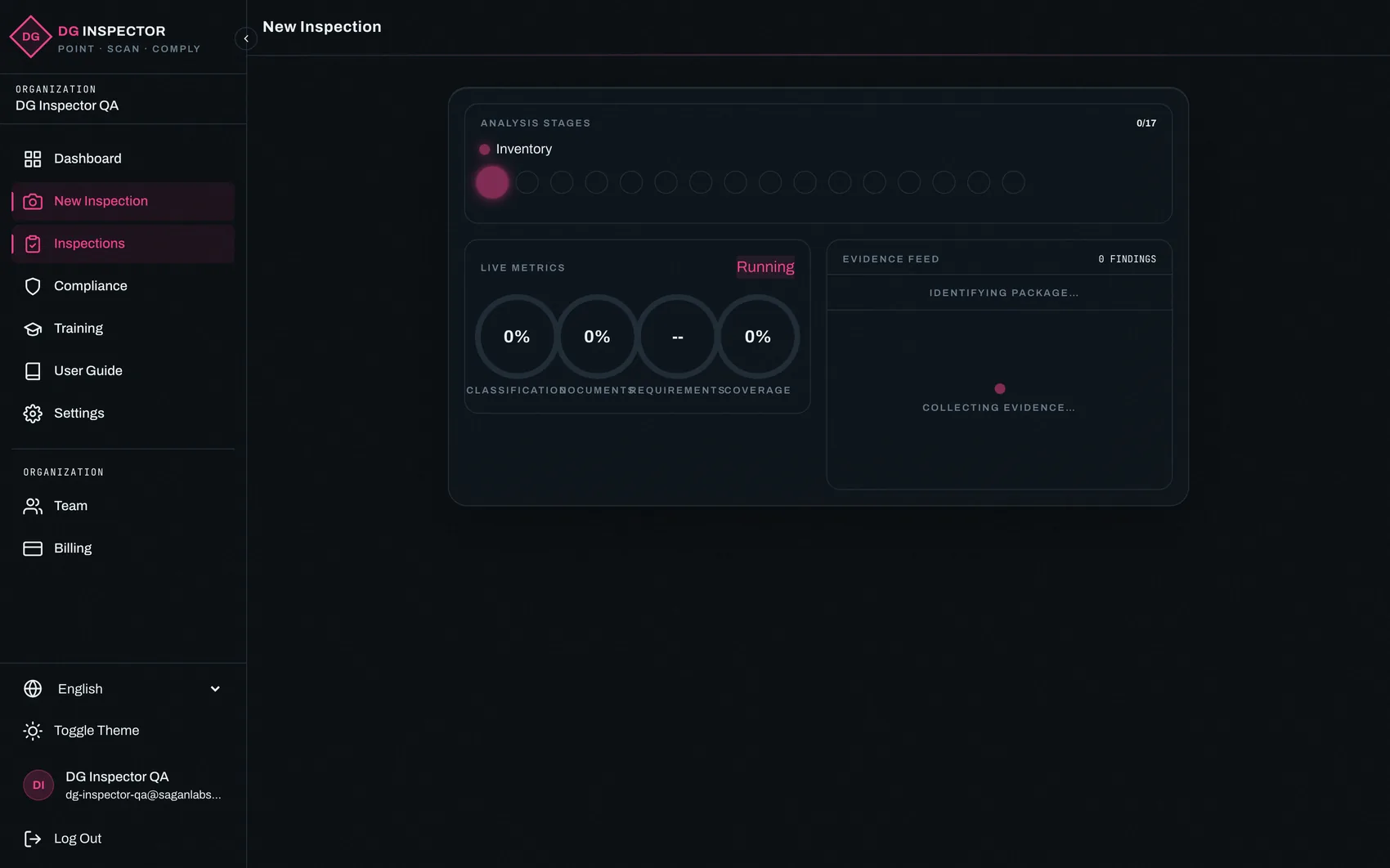
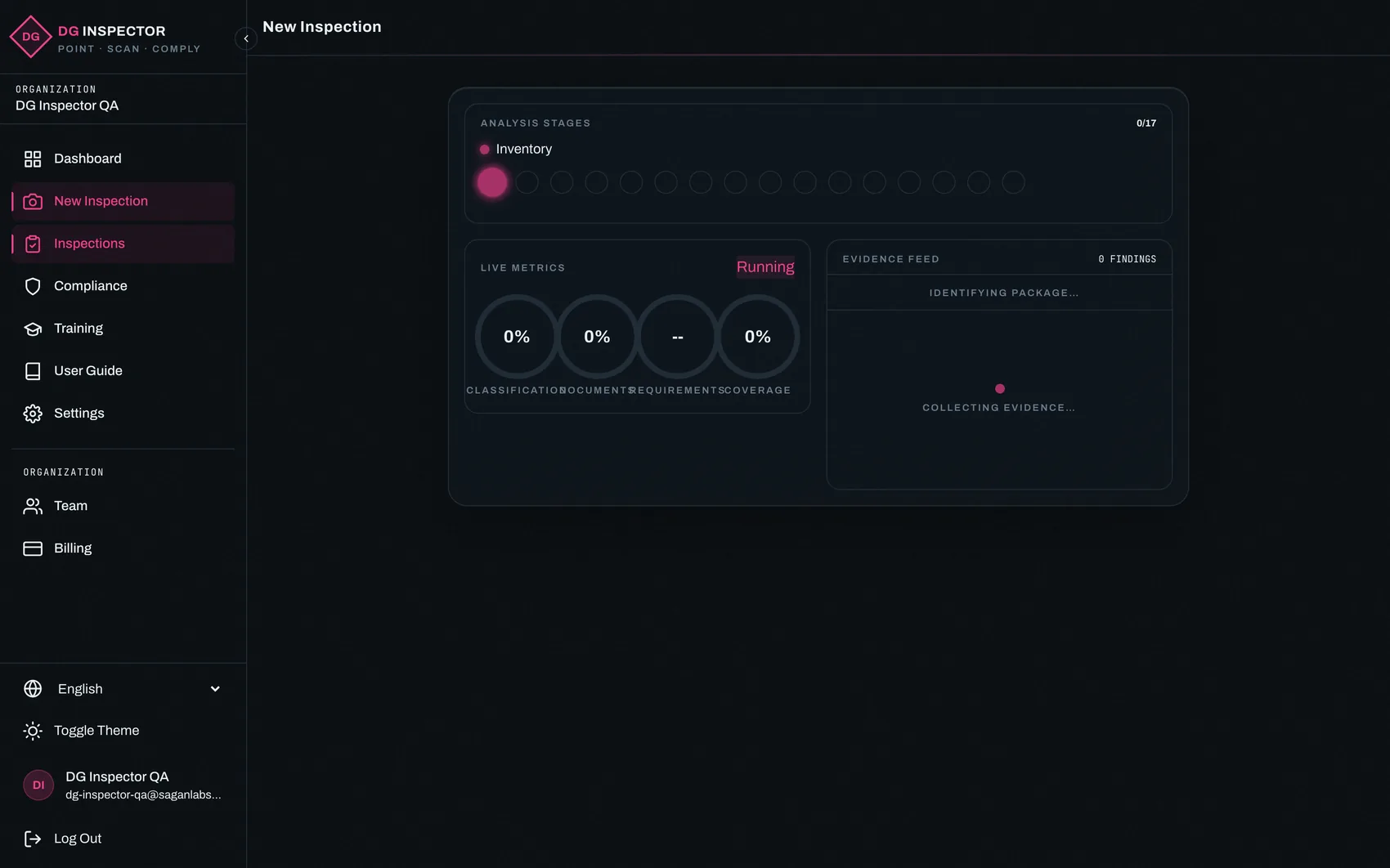
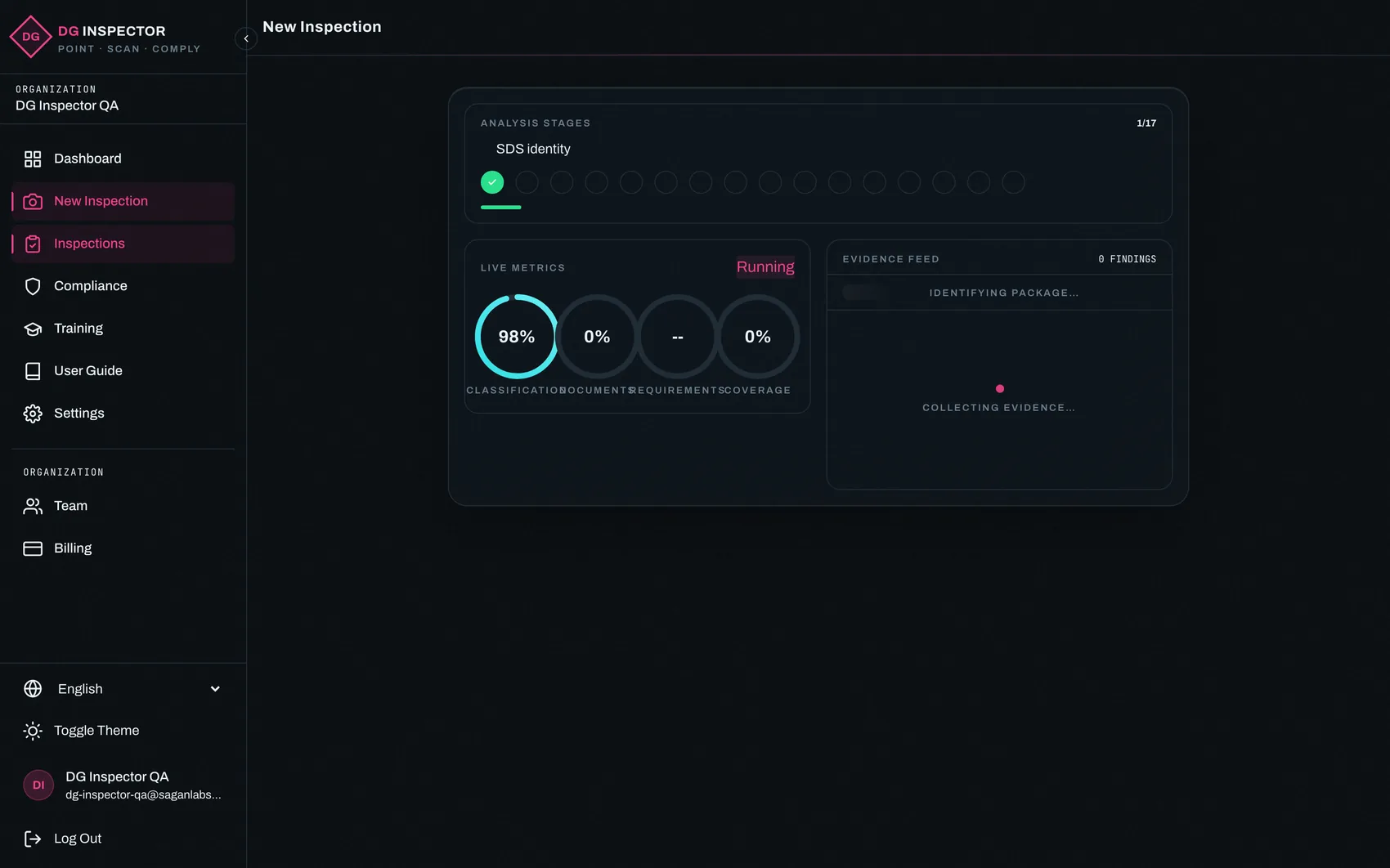
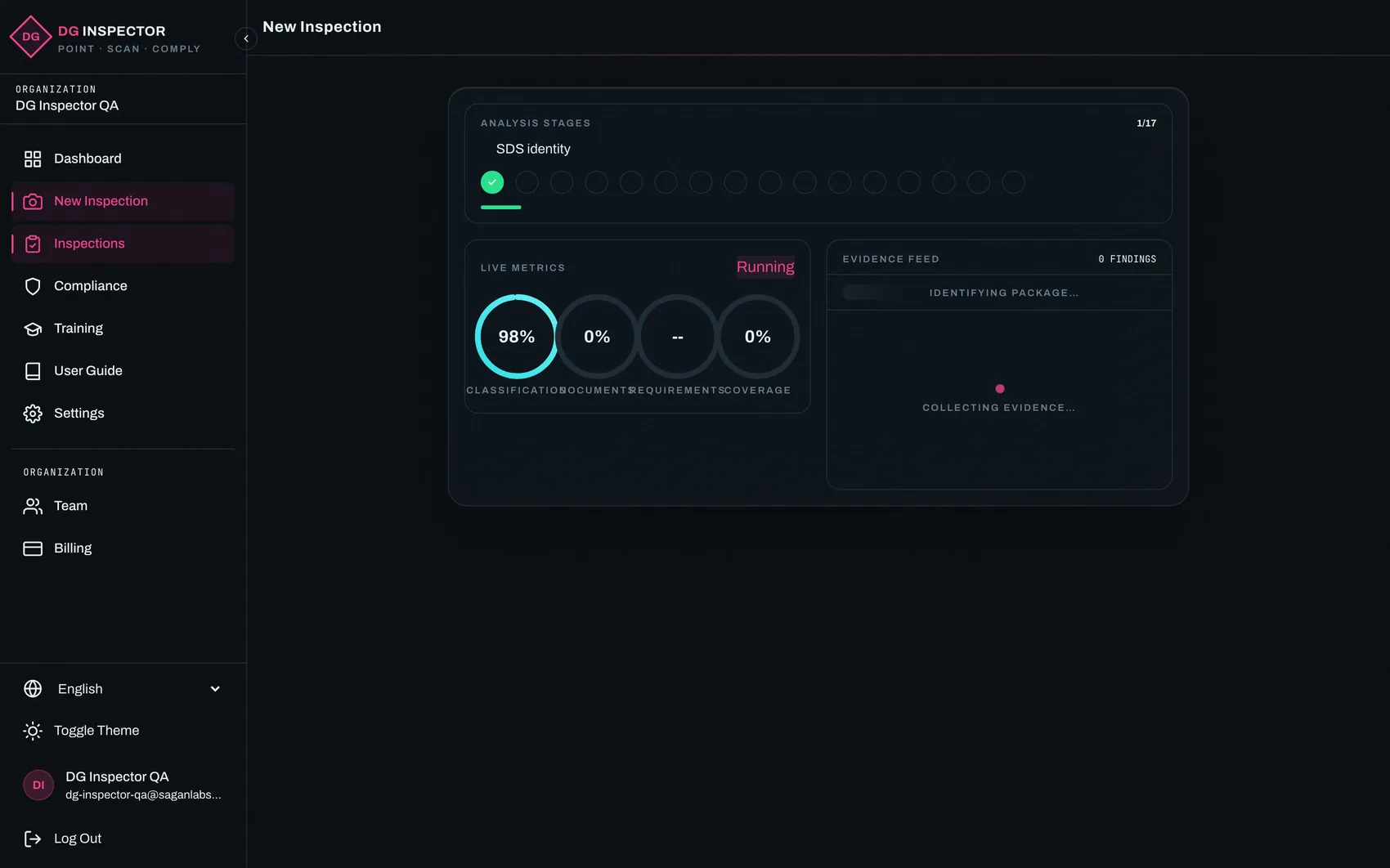
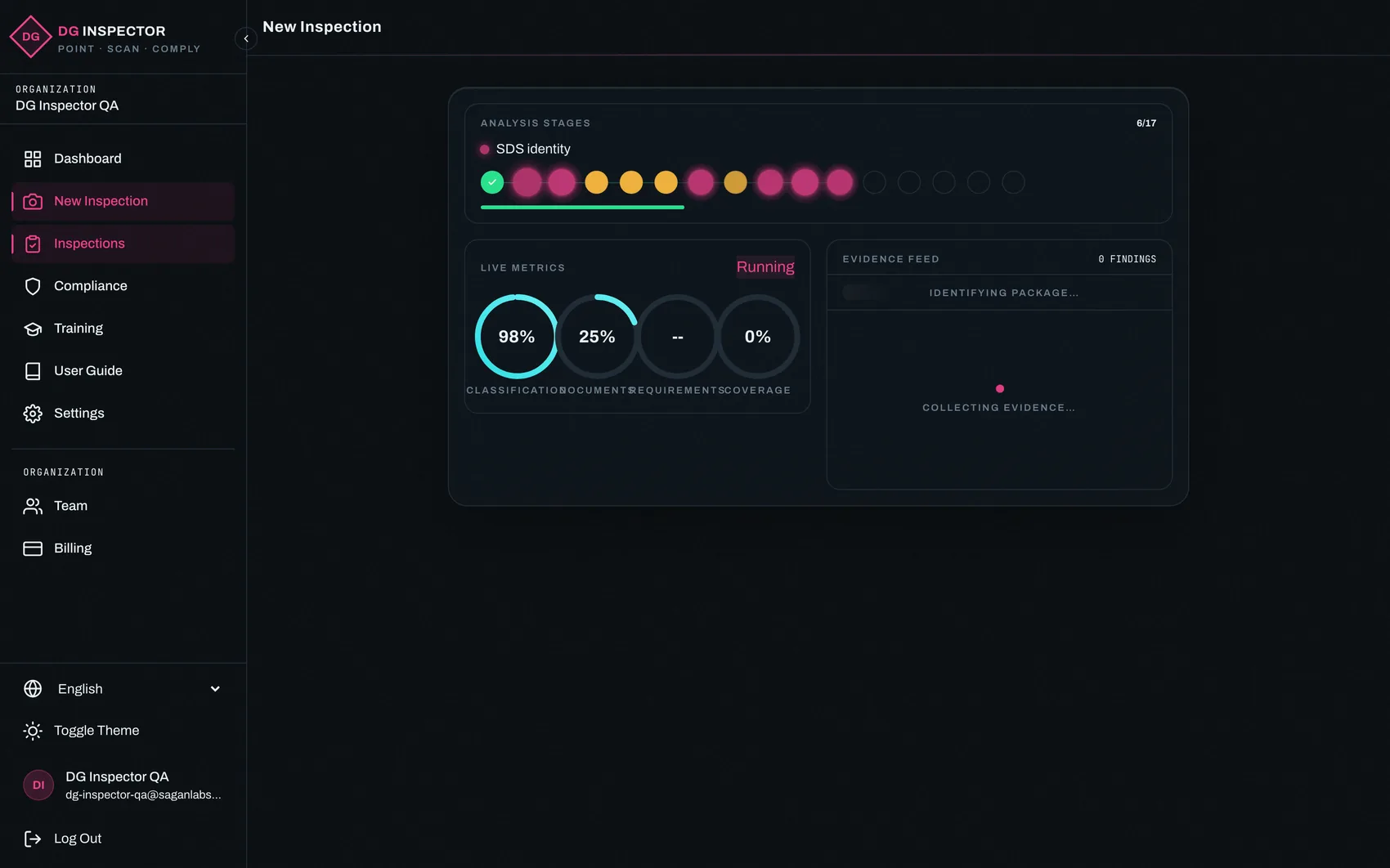
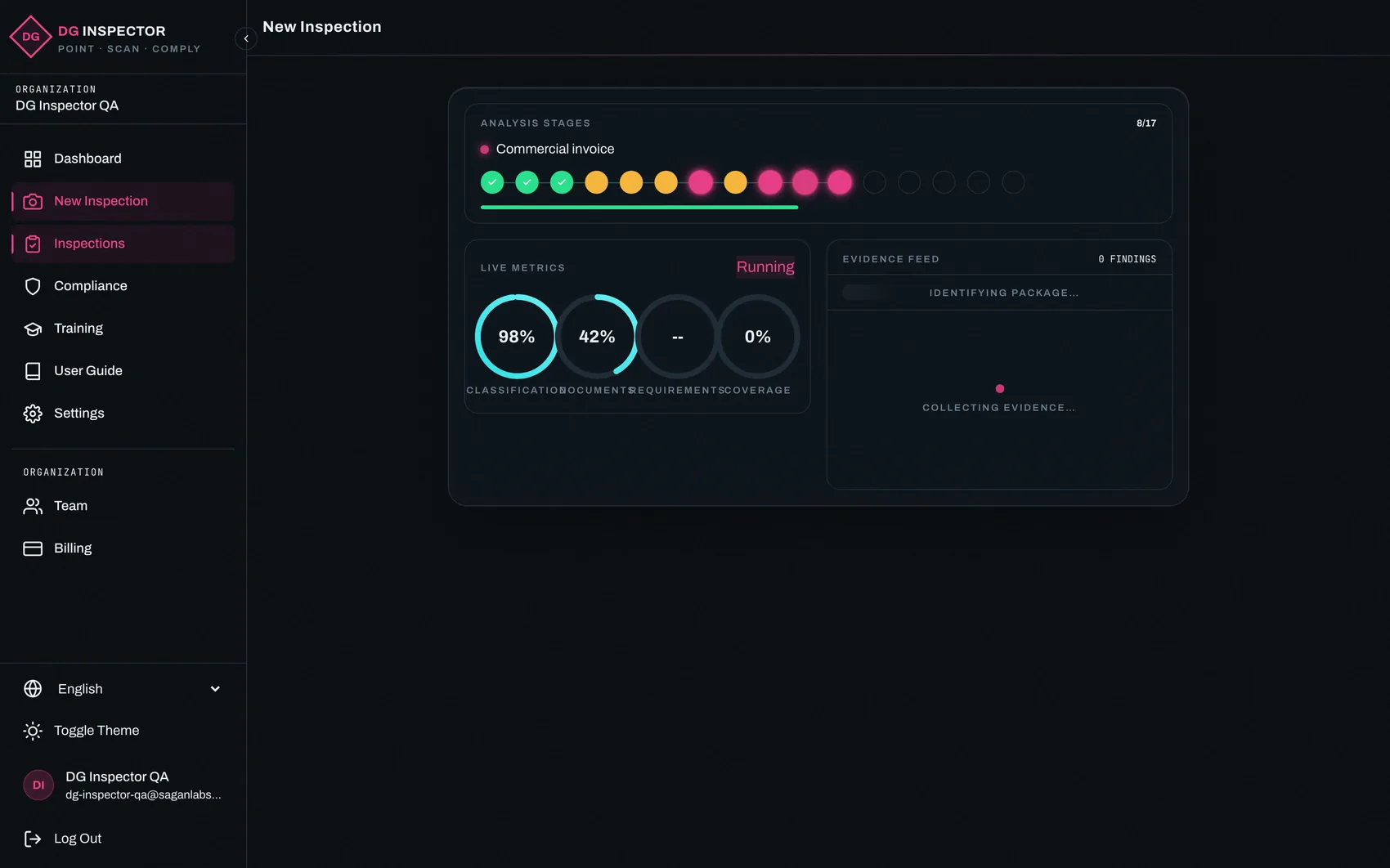
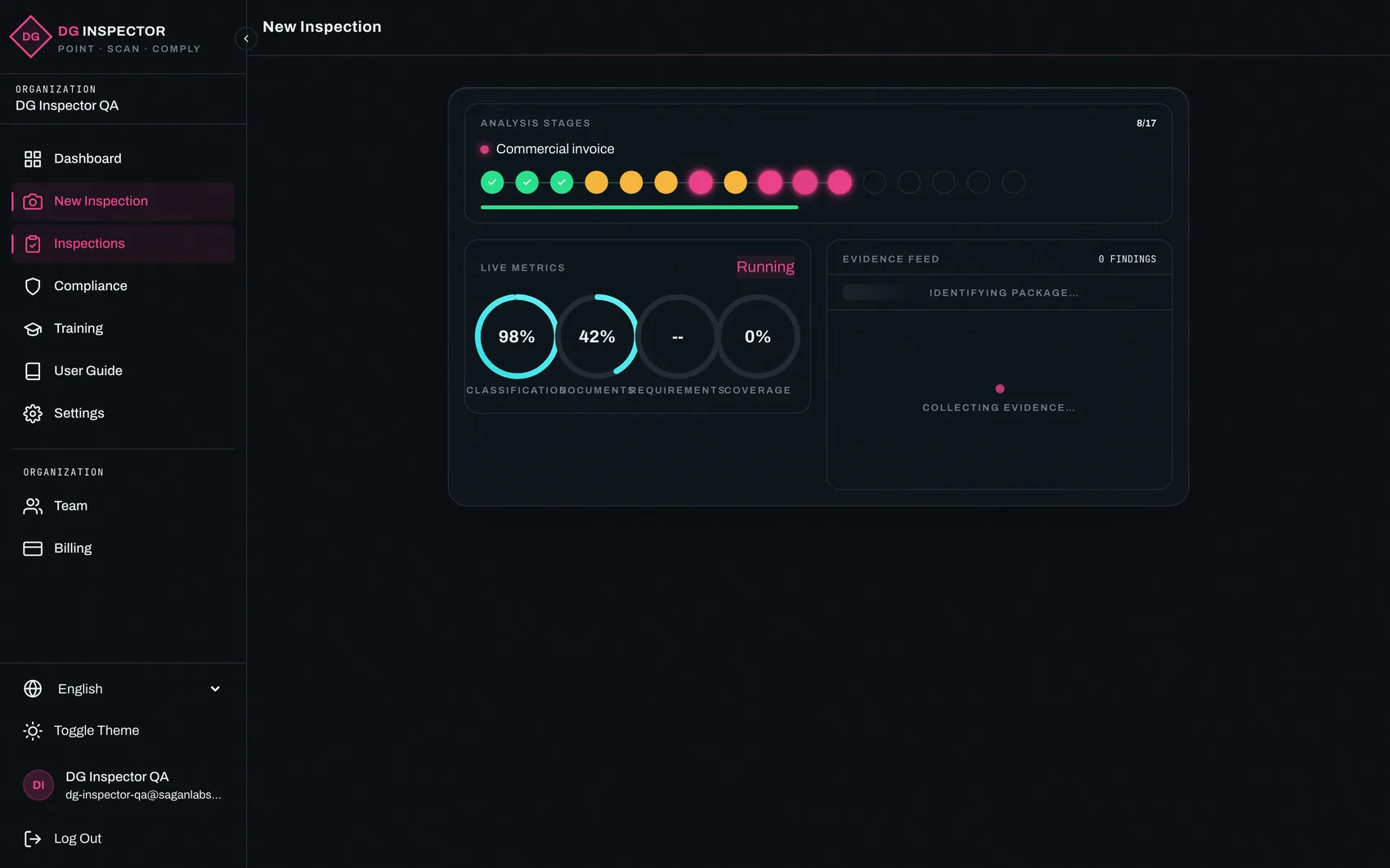
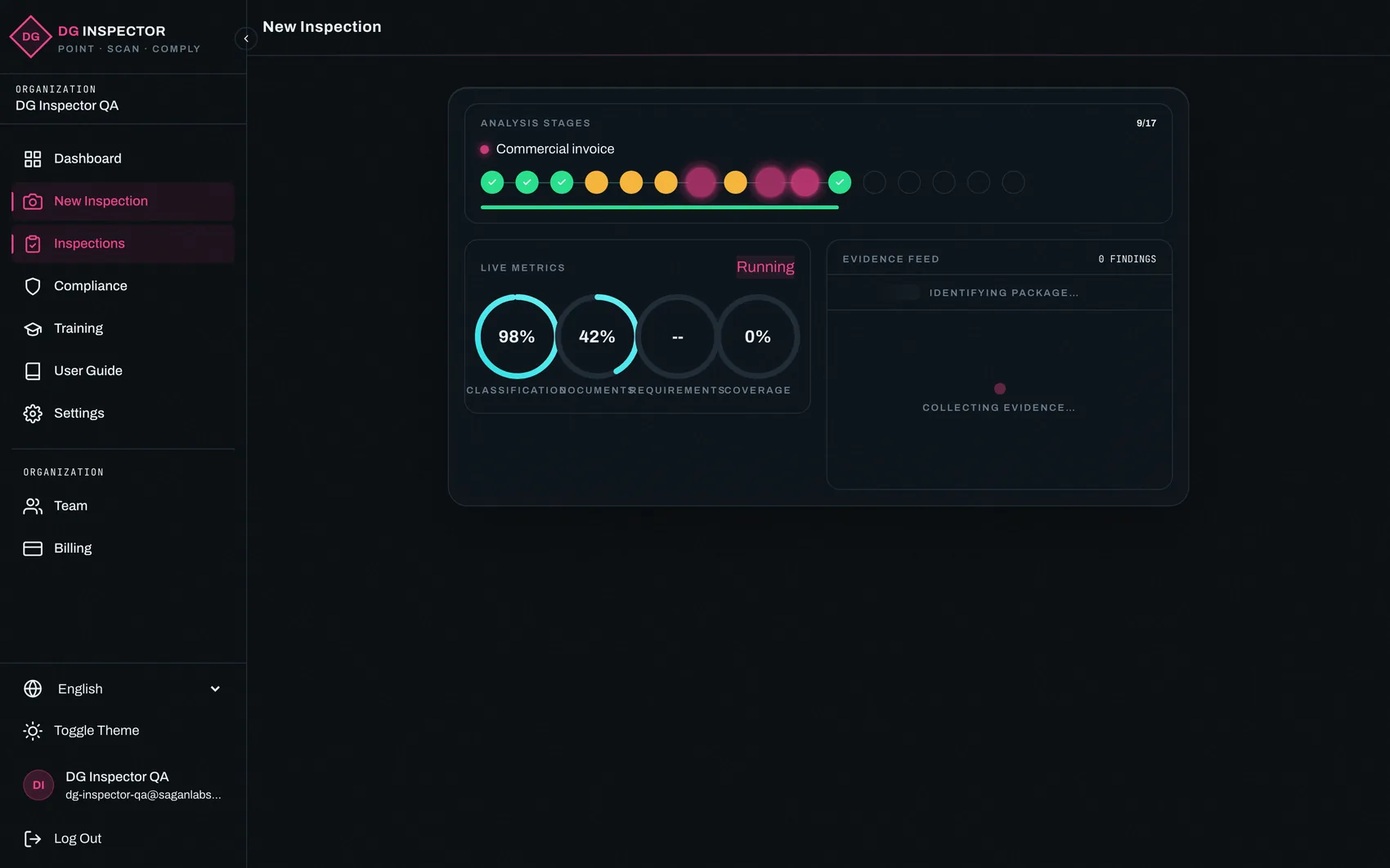
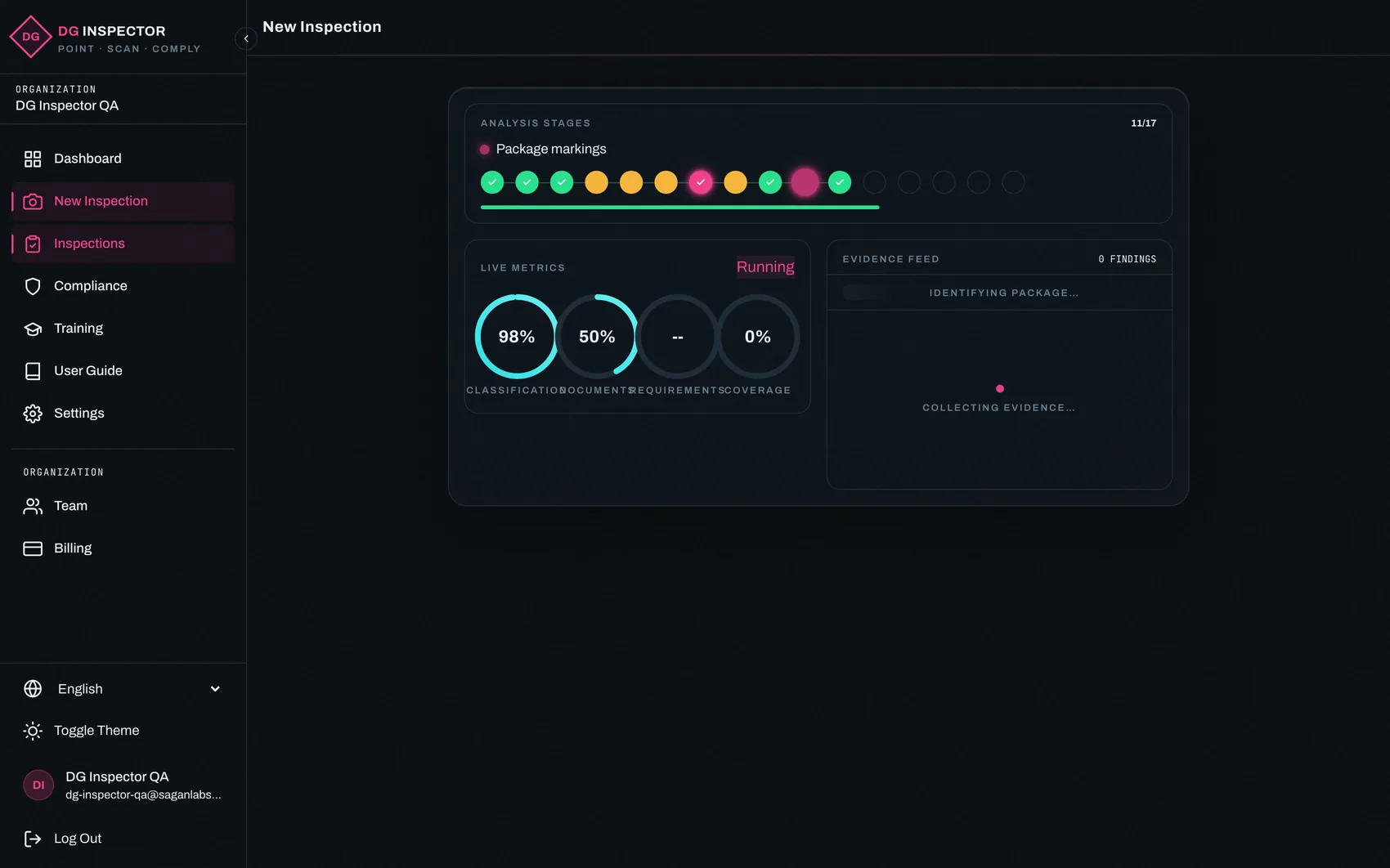
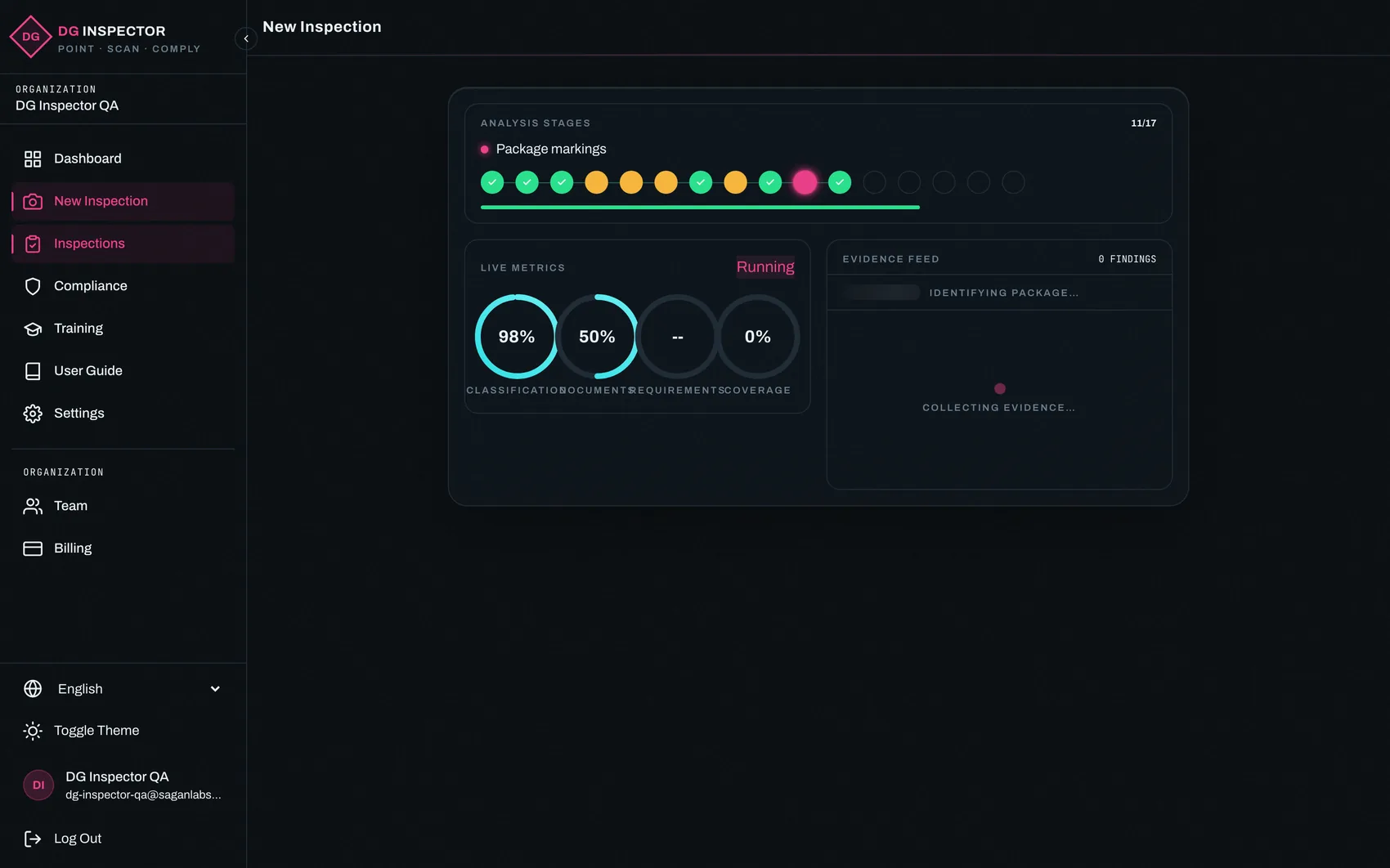
Sixty seconds, the real product, a real shipment: from package photo to an evidence-backed verdict.
From the first photo to a signed declaration: every step of a dangerous goods shipment, inspected with evidence.
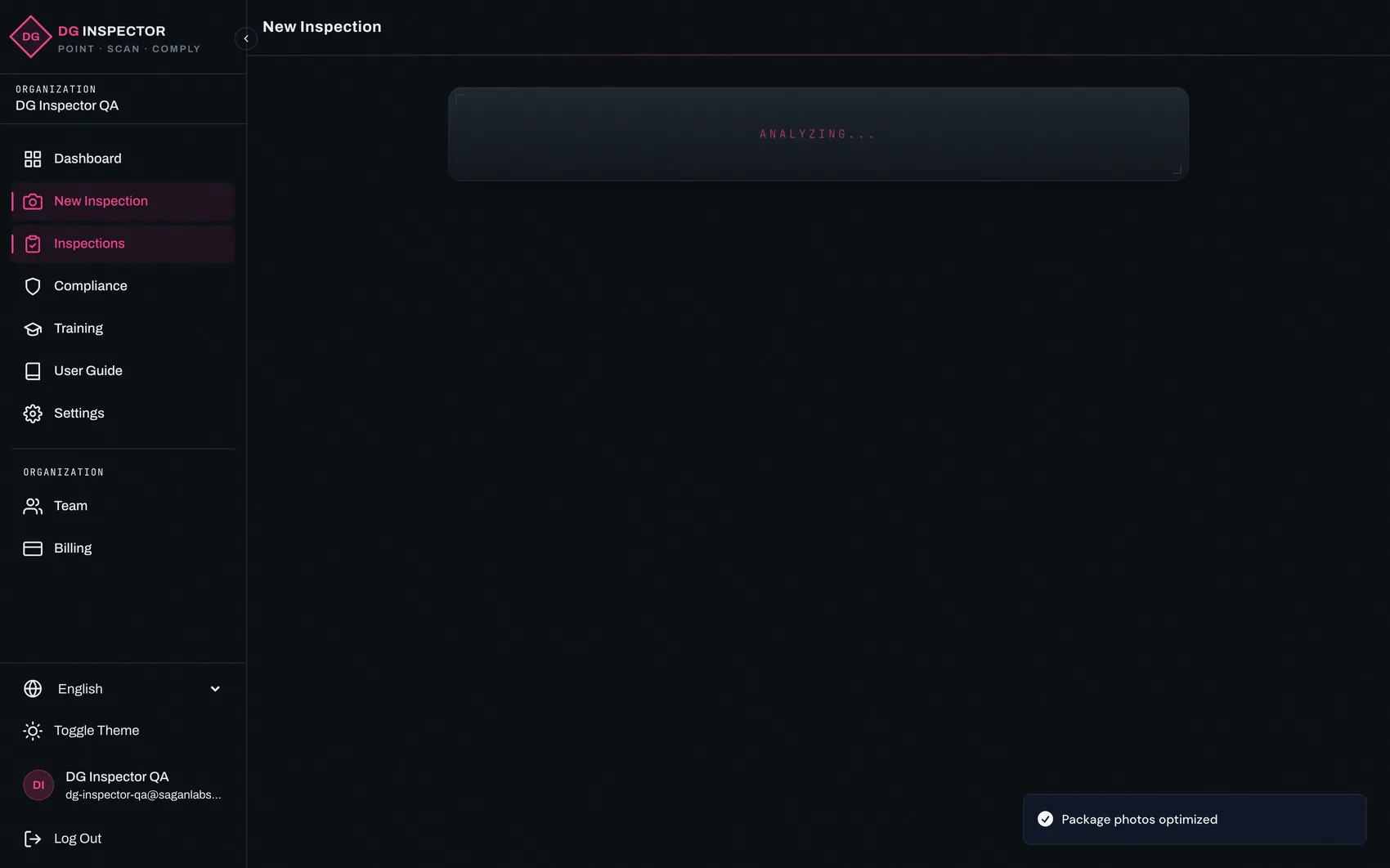
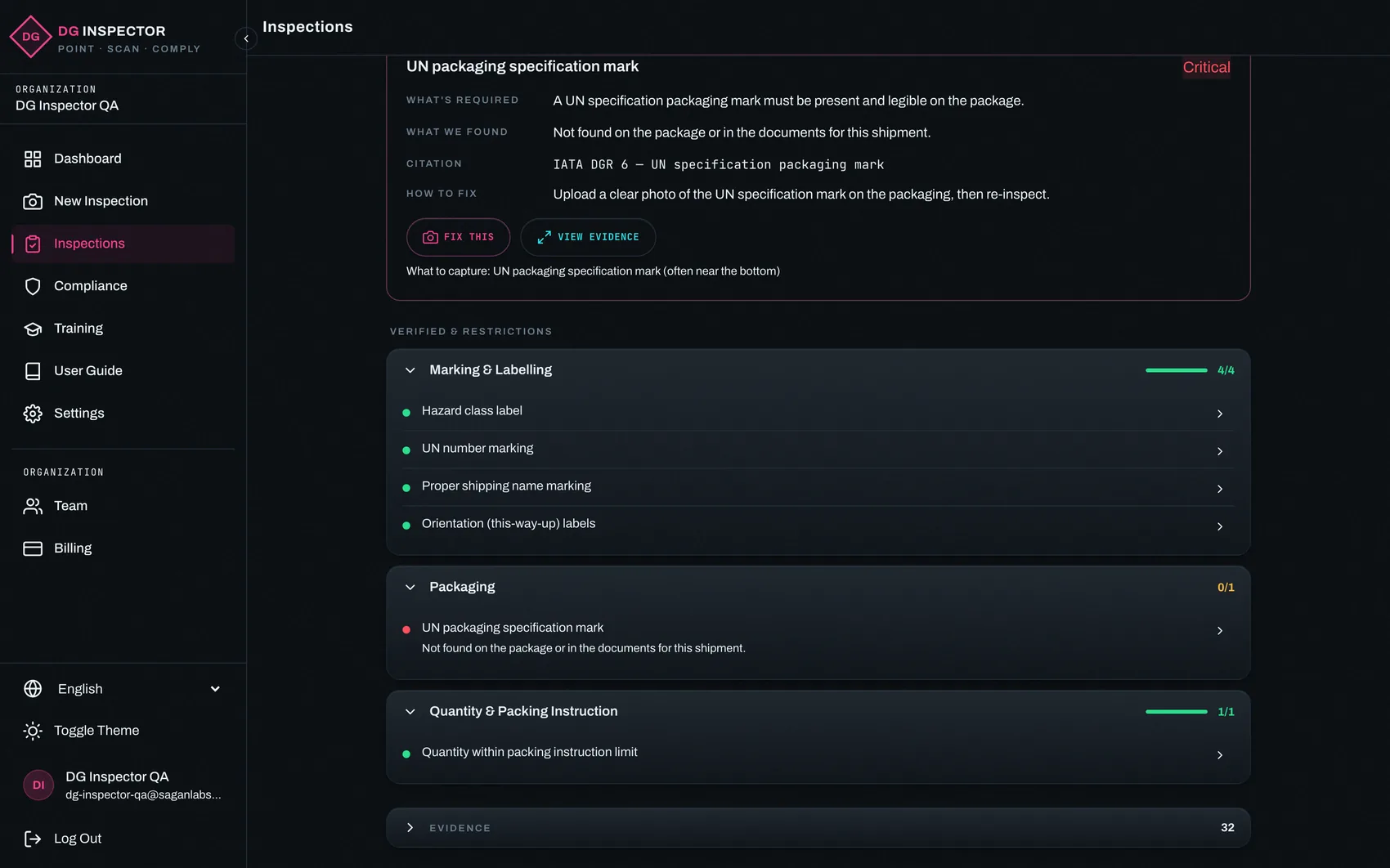
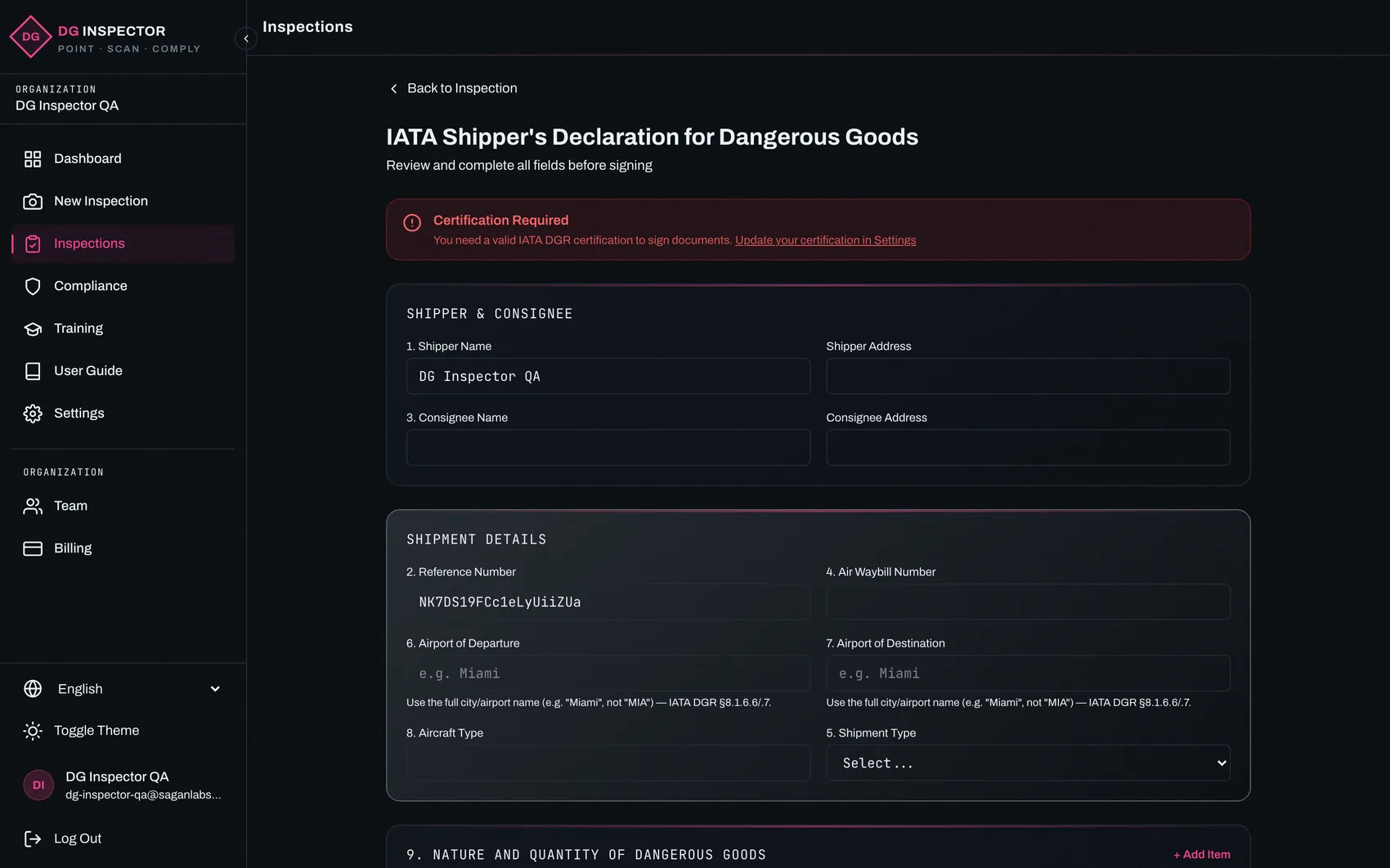
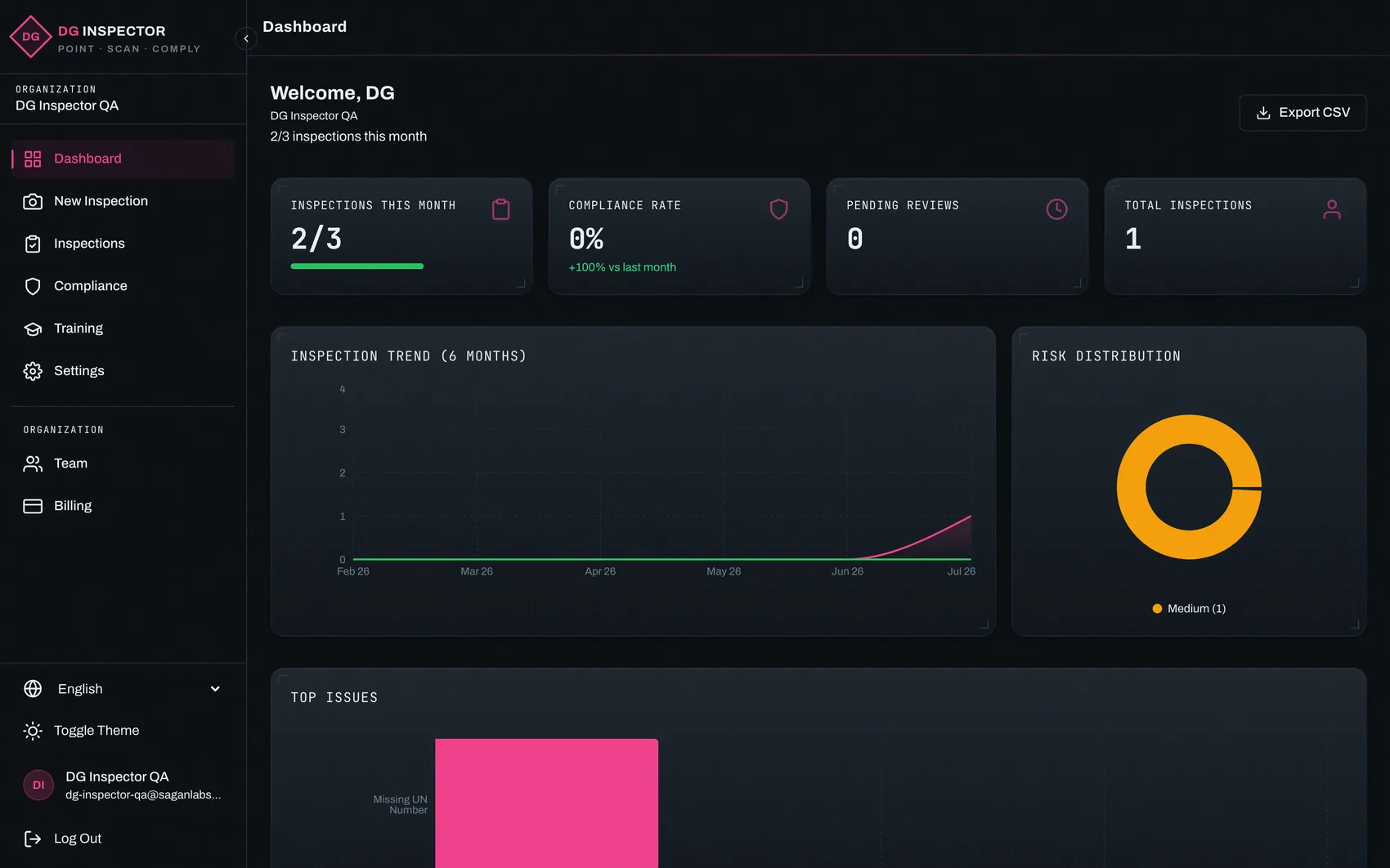
See it in action — run your first inspection in under 60 seconds.
Try Free — 3 Inspections IncludedNo training required. If you can take a photo, you can run a professional DG inspection.
Take a photo of the dangerous goods package with your phone camera or upload an existing image. The system accepts any angle — labels, placards, shipping papers, or full package shots.
Our advanced vision AI identifies UN numbers, proper shipping names, hazard classes, and packing groups. It cross-references against IATA DGR and IMDG Code to validate every detail.
Receive an instant compliance report: pass/fail status, specific issues found, required corrective actions, and a downloadable checklist. Share it with your team or export as PDF.
| Manual process | DG Inspector | |
|---|---|---|
| Classify the product | Page through the DGR or 49 CFR tables, cross-reference the SDS by hand. | Photo of package and documents: UN number, shipping name, class and packing group extracted and cross-checked in seconds. |
| Check 4 regulations | One book per mode; air, sea, ground and road each checked separately, if at all. | One scan resolves the requirements for the right mode automatically, all four frameworks supported. |
| Verify marks & labels | Visual check against memory or a printed checklist; misses are silent. | Every mark verified by value against the declared identity; mismatches surface as explicit contradictions. |
| Produce the DGD | Retype shipment data into a form; transcription errors are a leading rejection cause. | Declaration generated from inspection data and signed digitally; no retyping. |
| Evidence for audits | Hunt through email chains and photo folders months later. | Every verdict stores its evidence: photos, documents and rules, in one place. |
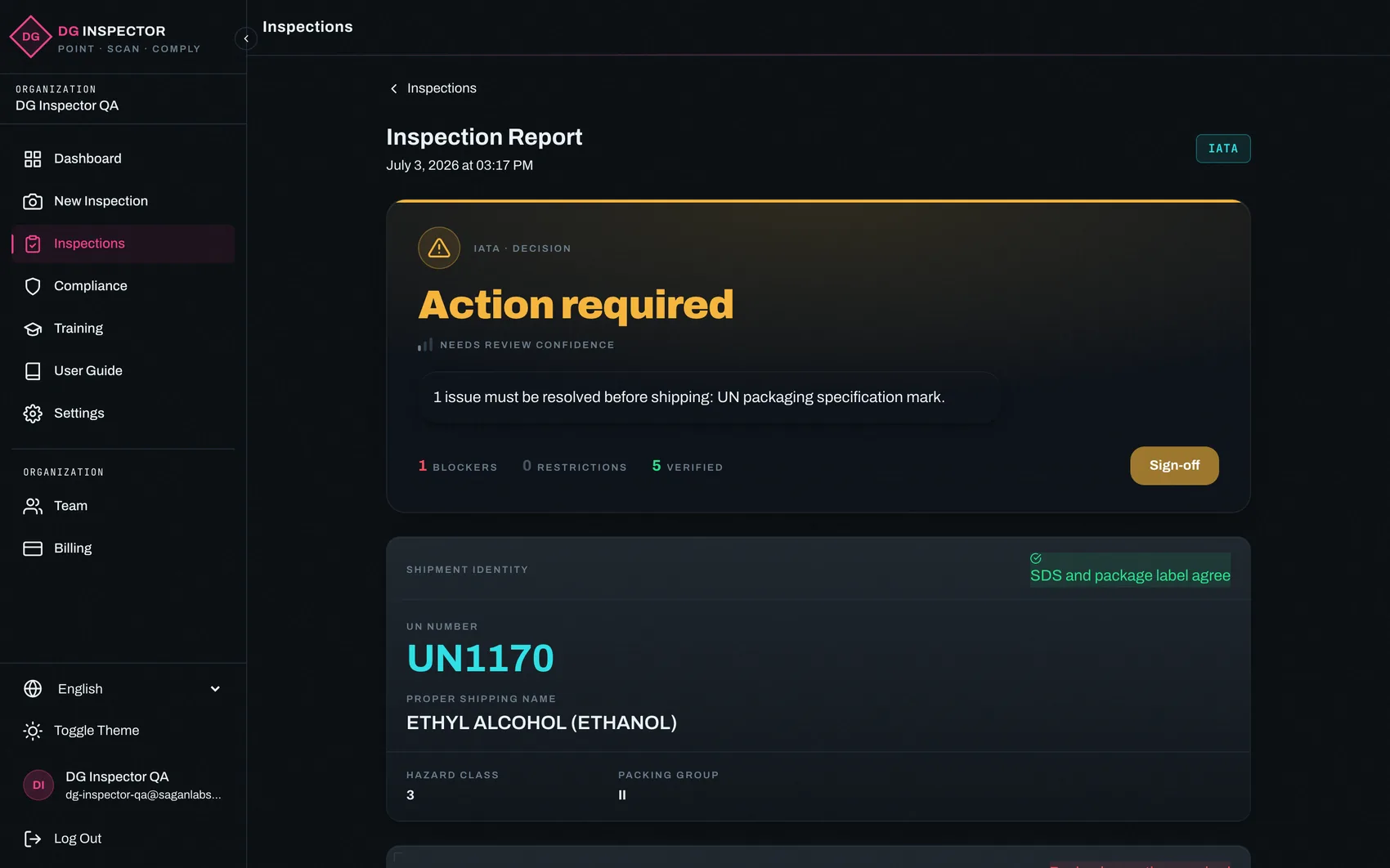
Dangerous goods compliance is a legal-risk decision. DG Inspector shows its work so you can verify every call.
Requirements are resolved from a curated dataset of UN numbers, hazard classes and packing groups — not improvised by a language model. Same shipment, same verdict, every time.
Marks and labels are credited only when their value matches the declared shipment. A Class 8 label on a Class 3 box is flagged as a contradiction — never silently passed.
Each detection carries a confidence score. Low-confidence reads return “needs review”, not a false pass — so a borderline call reaches a human instead of slipping through.
Every inspection is checked against IATA DGR, IMDG Code, 49 CFR and ADR — with the regulatory text preserved verbatim, so the citation behind each requirement is traceable.
Verify 50+ packages a day without DGR memorization
Point your camera at a package, get UN classification + compliance verdict in seconds. Stop flipping through the IATA DGR manual for every shipment.
Quote with confidence, know your shipment will fly
Run a pre-acceptance check before submitting the airwaybill. Catch labeling and packaging issues before they become $25,000 fines.
Audit trail and PDF reports built in
Every inspection generates a timestamped PDF report. Export the entire team's history, filter by regulation, and answer auditor questions in minutes.
Trusted by freight teams
Pre-acceptance checks that took the better part of an hour now finish before the truck leaves the dock.
Rejected shipments dropped to near zero once every package got scanned before handover.
Audits stopped being scary: every verdict comes with the photo evidence already attached.
New inspectors get productive in days: the app shows what to look for, the training mode does the rest.
Data is processed on Google Cloud (Firebase) infrastructure and encrypted in transit and at rest by default.
Every workspace is scoped to its own organization. Your inspections are never visible to another customer.
Temporary inspection-processing records auto-expire after 7 days. You keep your saved reports; transient data does not linger.
DG Inspector is a decision-support tool. Results are not a legal certification — always verify against the current edition of the applicable regulation before shipping.
Start free. Upgrade when you need more inspections or team features.
Try it out. No credit card required.
For professional inspectors and growing teams.
For freight companies and large operations.
Try it out. No credit card required.
Billed annually at $240/yr per seat. Save 20%.
For freight companies and large operations.
About Sagan Labs AI
Carl Sagan spent his life mapping the cosmos — turning the unknowable into something we could reason about. Dangerous goods compliance is its own dark continent: 4 regulations, 9 hazard classes, thousands of UN numbers, decades of accumulated rules.
Every shipment is a small expedition into that complexity. Sagan Labs AI builds the instruments to make those expeditions instant.
DG Inspector is our first product. We're just getting started.
From the blog
Practical guides on IATA DGR, IMDG, ADR and 49 CFR — written for the people actually moving the freight.
A PHMSA hazmat audit checks systems and records, not just a single shipment — here's what to expect and how to prepare documentation in advance.
Read articleDangerous goods training is required for anyone who classifies, packs, labels, or ships hazmat — with recurrency every 2 years under IATA, 3 under 49 CFR.
Read articleEvery dangerous goods shipment needs a monitored 24-hour emergency response number on the shipping paper — here's what [49 CFR](/blog/49-cfr-hazmat-compliance-checklist-us) §172.604 actually requires.
Read articleIt turns your phone camera into a compliance tool. Snap a photo of any dangerous goods package — labels, placards, shipping papers — and get a full compliance verdict in about 3 seconds. The system reads UN numbers, identifies hazard classes, and checks everything against IATA DGR and IMDG Code. No more flipping through 1,200-page regulation manuals.
Four frameworks: IATA DGR for air transport, IMDG Code for maritime, 49 CFR for US road transport (DOT/PHMSA), and ADR for European road transport. The only platform covering all four modes in a single interface. Each regulation set is updated within 30 days of new editions being published.
Yes. 49 CFR compliance for road (DOT hazmat shipping requirements, including HMR Parts 171–180), and IATA DGR for domestic air — both fully supported. The system automatically flags requirements that differ between domestic and international shipments.
Every result comes with a confidence score. If the system reads a damaged or partially obscured label, it tells you "78% confident — verify manually" instead of guessing blindly. The AI is calibrated to fail safely: when in doubt, it asks you to verify, never invents an answer.
Yes. You choose the regulation mode (IATA DGR or IMDG Code) before inspecting, or run both checks on the same package in parallel. The requirements differ — what passes for sea freight might fail for air — and DG Inspector flags exactly where the differences matter.
DG Inspector generates detailed inspection reports with timestamps, photos, classification data, and compliance verdicts. Many freight companies use these as part of their audit trail. While regulatory acceptance varies by jurisdiction, our reports are designed to meet the documentation requirements of IATA DGR Section 1.6 and IMDG Code Chapter 5.4.
Every classification is flagged with a confidence score. Low-confidence results (below 85%) are marked for manual review and won't auto-pass. You can override any classification, and your correction feeds back into the system. We also maintain a human review queue for edge cases — unusual packaging, rare UN numbers, or newly classified substances.
Yes. Every inspection generates a PDF report with the original photo, classification details, compliance verdict, and any corrective actions required. Pro and Enterprise plans include bulk export. Reports include QR codes that link back to the full digital record for verification.
You need an internet connection for the AI classification — it runs on cloud infrastructure for accuracy. But you can capture photos offline and queue them. When you reconnect, they process automatically. We're working on a lightweight on-device mode for basic hazard class identification.
All data is encrypted in transit (TLS 1.3) and at rest (AES-256). We don't share your data with third parties — period. Enterprise customers get data residency options and private endpoints. We're built on Google Cloud infrastructure with Firebase Authentication and Firestore security rules enforcing role-based access.
Yes. DG Inspector runs on the web and as native iOS and Android apps, currently rolling out in the App Store and Google Play. The mobile app includes AR Live-Scan for pointing your camera directly at packages.
AR Live-Scan reads your shipping documents first, then verifies the physical package live through your phone camera: marks, labels and orientation lock on in real time with evidence photos captured automatically.
Yes. Certified users can digitally sign the DGD in the IATA-compliant column format, generated directly from inspection data. 49 CFR shipping papers are supported too. Signing is gated to users with a valid certification on file.
The full product ships in English, Portuguese, Spanish, French and German, including localized AI analysis output and in-app video guides in English, Spanish and Portuguese.
Still have questions? Start with 3 free inspections and see for yourself.
Join inspectors who have replaced hours of manual lookups with 3-second AI classifications.
Start Free — No Credit Card